

Table of Contents
- Delaware LLC vs Wyoming LLC for Real Estate in 2026: The Complete Comparison
- Formation Costs, Filing Fees, and Annual Compliance: Delaware vs Wyoming
- State Taxes, Privacy, and Asset Protection Compared
- Foreign LLC Registration for Real Estate: What Happens When You Form Out of State
- One LLC per Rental Property: When It Makes Sense and When It Doesn't
- Real Estate LLC Asset Protection: Charging-Order Protection, Insurance, and Financing
- The Best State to Form an LLC for Real Estate: A Decision Framework for 2026
- Conclusion: Matching the State to Your Real Estate Strategy
- Frequently Asked Questions
Last Updated: October 9, 2026
Delaware LLC vs Wyoming LLC for Real Estate in 2026: The Complete Comparison
The delaware llc vs wyoming llc for real estate 2026 question comes down to one idea: Wyoming wins on cost, privacy, and charging-order protection for most rental investors, while Delaware wins on corporate legal infrastructure and investor familiarity.

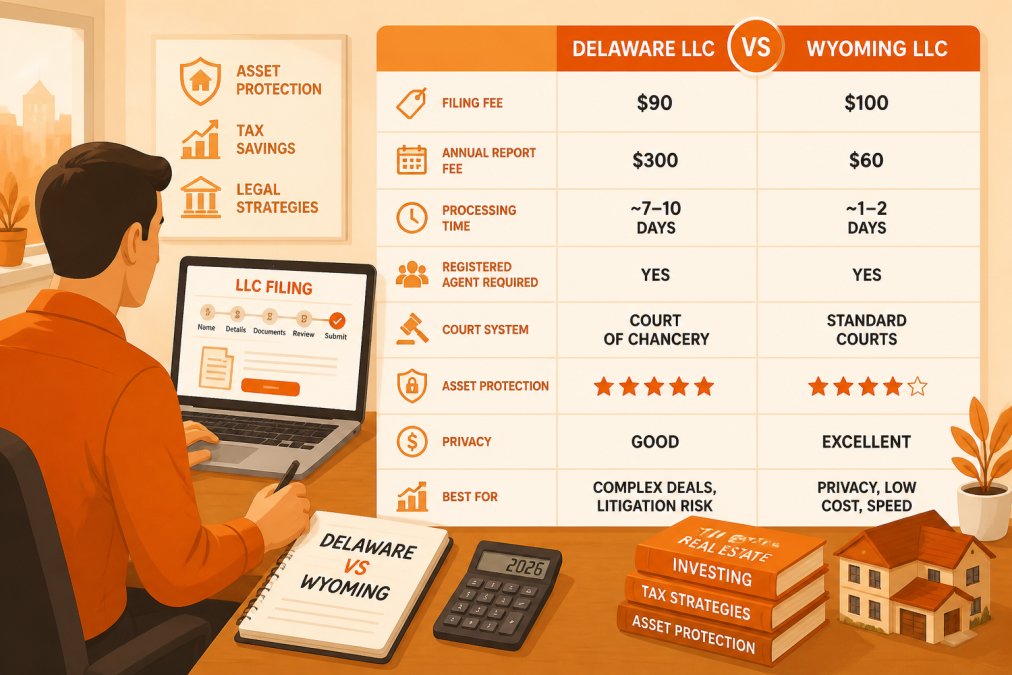
An LLC separates your personal assets from the business's liabilities, and the formation state changes your fees, privacy, and lawsuit exposure. Both states deliver that core protection; they differ in cost, disclosure, and legal culture.
A common mistake is assuming the state with the strongest corporate reputation is best for rental property. Delaware's advantage is built for publicly traded companies and venture-backed startups, not a duplex in another state.
Formation Costs, Filing Fees, and Annual Compliance: Delaware vs Wyoming
Wyoming is cheaper to form and maintain for most real estate investors, though the gap is smaller than the marketing suggests.
Delaware charges a higher franchise tax and a separate annual report fee, and its registered agent market runs more expensive.
| Cost Item | Delaware | Wyoming |
|---|---|---|
| Formation filing fee | Higher | Lower |
| Annual report / franchise tax | Higher, recurring | Lower, recurring |
| Registered agent | More expensive | Less expensive |
| State income tax on LLC | None (pass-through) | None (pass-through) |
| Best for | Corporate investors | Rental property owners |
The five-year cost matters more than the first-year cost. Investors who compare only the formation fee miss the compounding effect of annual report and agent fees.
State Taxes, Privacy, and Asset Protection Compared
Privacy is the clearest difference between the two states, and it favors Wyoming.
Neither state imposes a state income tax on a pass-through LLC's profits.
Both states offer charging-order protection, which limits a creditor of a member to a charging order against distributions rather than letting them seize the membership interest outright.
A poorly structured LLC can cost you thousands in lost savings and exposure to legal risks. Our LLC for Real Estate Investing guide walks investors through entity choice line by line.
Foreign LLC Registration for Real Estate: What Happens When You Form Out of State
Foreign LLC registration is the requirement that an out-of-state LLC register to do business in the state where it actually operates, the step most investors skip until it costs them.
The trap: investors form in Wyoming for privacy, buy a rental in their home state, and never register locally. The result is a company not authorized to do business where it operates, which can affect your ability to enforce a lease, defend a lawsuit, or close a refinance.
Owning Property vs. Conducting Business: The Distinction That Decides Everything
Owning real estate and conducting business in a state are two different legal questions. A passive investor holding a single rental and collecting rent may, in some states, fall outside the definition of "doing business" and avoid foreign qualification.
The rules are state-specific and change. Some states publish a statutory list of activities that do not constitute doing business, maintaining a bank account, holding a single property for investment, owning real estate in the entity's name.
What Foreign Qualification Actually Requires
When you do need to register, the process is usually called a Certificate of Authority or Application for Registration. The filing typically requires:
- The LLC's legal name and its home state of formation.
- A registered agent physically located in the property state.
- A certificate of good standing from the formation state, often issued within the last 30-90 days.
Once registered, the LLC takes on a second set of obligations: a separate annual or biennial report in the property state, a second registered agent fee, and in some states a foreign entity franchise or privilege tax. That is the cost most formation-fee comparisons never show.
The Five-Year Cost of Owning Out of State
A realistic five-year view of an out-of-state rental held in a Wyoming LLC looks like this:
| Cost Layer | Paid To | Recurring? |
|---|---|---|
| Wyoming formation filing | Wyoming | One time |
| Wyoming annual report / license tax | Wyoming | Annual |
| Wyoming registered agent | Private agent | Annual |
| Property-state foreign qualification | Property state | One time |
| Property-state annual report | Property state | Annual |
| Property-state registered agent | Private agent | Annual |
| Property-state franchise or privilege tax (if any) | Property state | Annual or as assessed |
| Federal and state tax return prep | CPA | Annual |
Two registered agents, two annual reports, two filing calendars. The formation state is one line item; the property state is the rest of the ledger.
What Happens If You Skip It
Operating an unregistered foreign LLC where registration is required can trigger penalties, back fees, interest, and, worst case, limits on the LLC's ability to sue or enforce contracts in that state's courts. A tenant who stops paying rent is a problem; one who discovers your LLC was never authorized to do business there is a bigger one.
The practical rule: form in the state that makes sense for your strategy, then register as a foreign entity in every state where you hold property or conduct business. The formation state and the operating state are two different decisions, and confusing them is a common structuring error.
One LLC per Rental Property: When It Makes Sense and When It Doesn't
One LLC per rental property makes sense when a single property carries enough value or liability risk that a lawsuit against it could threaten your other assets.
The logic is liability separation: if each property sits in its own LLC, a slip-and-fall at Property A cannot reach Property B.
LLC for Real Estate Investing: LLC vs Corporation Guide →
- Use separate LLCs when properties are high-value, high-traffic, or in litigious markets.
- Use a single LLC when properties are low-value and you are just starting out.
- Consider a series LLC in states that recognize it, which can hold multiple properties under one umbrella with separate liability cells.
Our Premier LLC E-Book covers the series LLC versus traditional LLC decision in detail, including the common mistakes that leave investors with protection on paper only.

Real Estate LLC Asset Protection: Charging-Order Protection, Insurance, and Financing
Insurance and financing requirements often decide the state question before asset protection does. Most lenders want the LLC to be the borrower, and many will not lend to an entity formed in a state where they cannot easily enforce a mortgage.
Real estate LLC asset protection works best as a stack: the entity provides the liability shield, charging-order protection defends the membership interest, landlord insurance covers property-level risk, and financing terms determine whether the structure is workable at all.
How Lenders Actually Underwrite an LLC-Owned Rental
A conventional residential mortgage is written for individuals, not entities. When the borrower is an LLC, the lender typically moves the loan into a commercial or portfolio product: shorter amortization, higher rates, and a personal guarantee from every member.
Watch the due-on-sale clause: standard mortgage documents let the lender accelerate the loan if title transfers without consent, and deeding a property into a newly formed LLC is a transfer.
Title, Insurance, and the Transfer Mechanics
When property moves into an LLC, the title company runs a new search, issues a new policy, and the deed is re-recorded in the entity's name, real costs in title insurance, recording fees, and often a new lender title policy on a refinance.
A standard homeowner's policy will not cover a rental. You need a landlord policy or commercial property policy in the LLC's name, plus a personal umbrella above it.
The Tax Reality: Formation State Is Not a Tax Strategy
Neither Wyoming nor Delaware taxes a pass-through LLC's profits, and that is where the good news ends. Rental income is sourced to where the property sits, not where the LLC was formed.
A Wyoming LLC holding a rental in a high-tax state does not shelter that income from the property state. The formation state affects fees, privacy, and legal culture, not the tax treatment of the rental.
For investors who want the full framework, our LLC Master Machine & Equity Stripping Excel Bundle combines entity structuring with equity stripping, a strategy that reduces the exposed equity a plaintiff can target.

The Best State to Form an LLC for Real Estate: A Decision Framework for 2026
The best state to form an LLC for real estate depends on three variables: where the property sits, how much privacy you need, and how your lender wants the deal structured.
Use this framework:
- List every state where you hold or plan to hold property.
- Confirm the property state's foreign registration rules and fees.
- Decide how much ownership privacy you actually need.
- Ask your lender which entity and state it will accept.
For most rental investors, Wyoming wins on cost and privacy. Delaware wins when you need its corporate legal framework or your investors expect it. The property state always gets a foreign registration either way.
Conclusion: Matching the State to Your Real Estate Strategy
The state on your formation certificate matters far less than the structure behind it.
Information Services Unlimited provides real estate-specific structuring systems, including an operating agreement with 240+ legal provisions, tax elections designed to secure maximum deductions, and step-by-step guidance for new and existing LLCs.
Get started with Information Services Unlimited and put a structure behind your portfolio that holds up when it counts.
Frequently Asked Questions
Is Delaware or Wyoming better for a real estate LLC?
Neither state is automatically better for real estate. Delaware offers the Court of Chancery and a developed business legal system, which can help with investor confidence and complex governance. Wyoming provides strong charging-order protection, low annual fees, and privacy. However, if your rental property is in another state, you must also register as a foreign LLC there, which adds cost and compliance. The right choice depends on your portfolio, financing, and privacy needs.
Should I form my real estate LLC in the state where my property is located?
Often, yes. Forming in the property state simplifies compliance, avoids foreign registration fees, and can reduce legal complexity if a dispute arises. However, if you invest in multiple states or want privacy, an out-of-state LLC may be beneficial. You must still register in the property state as a foreign LLC. Weigh total costs, privacy, and asset protection against the convenience of a single-state structure.
Do I need to register a Delaware or Wyoming LLC in the state where my property is located?
Yes. If your LLC owns or manages rental property in another state, that state typically requires foreign qualification. You will need a registered agent in that state and must pay any applicable fees and annual reports. Operating without foreign registration can lead to fines, back taxes, and the inability to enforce leases or contracts in court. Check the property state's secretary of state website for exact requirements.
What are the annual fees for a Delaware LLC and a Wyoming LLC?
Delaware charges a $300 annual franchise tax for LLCs. Wyoming's annual report license tax is based on assets located in Wyoming, with a minimum of $60. If you own property in another state, you will also pay that state's annual fees. For example, many states charge between $50 and $200 per year. Always verify current fees on the respective secretary of state websites, as they can change.
Can a Wyoming LLC own property in another state?
Yes, a Wyoming LLC can own property in another state, but it must register as a foreign LLC in that state. This involves filing a foreign qualification application, paying fees, and maintaining a registered agent there. Once registered, the Wyoming LLC can hold title, sign leases, and manage the property. Failure to register can result in penalties and legal complications.