

Table of Contents
- Why Most LLCs Fail to Protect Personal Assets
- LLC Operating Agreement for Asset Protection: The 240+ Provision Standard
- Piercing the Corporate Veil Prevention: Maintaining Your Liability Shield
- Holding Company Structure for Real Estate: Separating Assets from Operations
- Best States for LLC Asset Protection: Wyoming, Nevada, and Delaware
- Insurance vs. LLC Protection: Which Do You Need?
- Post-Formation Maintenance Checklist for Long-Term Protection
- Frequently Asked Questions
Last Updated: September 22, 2026
Why Most LLCs Fail to Protect Personal Assets
An LLC shields personal assets from business debts and creditor claims, but only when formed and operated correctly. Most fail because owners treat formation as a one-time filing rather than an ongoing discipline, leaving the liability shield full of holes.
The gap is documentation, not paperwork volume.

LLC Operating Agreement for Asset Protection: The 240+ Provision Standard
A strong LLC operating agreement for asset protection does three things: confirms the LLC's separate legal identity, defines member-managed or manager-managed authority, and limits what a creditor can reach inside the entity. State website templates rarely accomplish all three.

- Charging order language that directs courts to the statutory remedy rather than a foreclosure on membership interests
- Capital contribution and distribution rules that establish adequate capitalization on paper
- Successor and transfer restrictions that block involuntary assignment of a membership interest to a creditor
- Fiduciary duty and indemnification clauses that protect managers acting in good faith
- Tax election and tax matters provisions that lock in the treatment the owner intended
Piercing the Corporate Veil Prevention: Maintaining Your Liability Shield
Piercing the corporate veil prevention comes down to proving the LLC is genuinely separate from its owner. Courts look for failures in formalities, finances, and fraud. Control the first two and the third almost never arises.
Keep these habits non-negotiable:
- Sign contracts and leases in the LLC's name, never personally
- Maintain a dedicated business bank account and business credit card
- File annual reports and pay franchise taxes on time in the state of formation
- Document major decisions with written resolutions
- Keep business and personal financial records strictly separate
- Capitalize the entity adequately at formation and after major distributions
Holding Company Structure for Real Estate: Separating Assets from Operations
A holding company structure for real estate places title to investment properties in one entity and day-to-day operations in another. If a tenant sues over a property condition, the claim hits the operating entity, and the holding company's real estate stays out of reach.
The structure typically looks like this:
| Layer | Entity | Holds | Purpose |
|---|---|---|---|
| Top | Holding LLC | Membership interests in operating LLCs | Isolates asset ownership from operations |
| Middle | Operating LLC | Leases, management contracts | Absorbs day-to-day liability |
| Bottom | Property LLCs | Individual properties | Segregates each asset from the others |
Best States for LLC Asset Protection: Wyoming, Nevada, and Delaware
The best states for LLC asset protection are Wyoming, Nevada, and Delaware, each offering statutory features many home states do not. The differences matter most when a creditor tries to reach inside the entity.
| State | Key Advantage | Charging Order Protection | Best For |
|---|---|---|---|
| Wyoming | Strong charging order statute, low fees, privacy | Explicit and exclusive remedy | Most real estate investors |
| Nevada | No state income tax, strong privacy laws | Statutory charging order protection | Investors prioritizing privacy |
| Delaware | Developed case law, business-friendly courts | Charging order protection with precedent | Multi-member and partnership structures |
Insurance vs. LLC Protection: Which Do You Need?
What each layer actually covers:
- Commercial general liability (CGL), third-party bodily injury and property damage on premises or arising from operations. This is the first line for a tenant slip-and-fall or a contractor injury.
- Commercial property insurance, the building and contents themselves, separate from liability.
- Umbrella or excess liability, sits above the CGL and auto policies and responds once the underlying limits are paid. Umbrella coverage is typically sold in $1 million increments, and most carriers require underlying limits of $250,000 to $500,000 per occurrence before the umbrella will attach.
- Professional liability / errors and omissions (E&O), covers negligent advice or management acts. An LLC does not shield an owner from personal liability for the owner's own tortious conduct, so this coverage matters for managers who make decisions.
- Workers' compensation, required in nearly every state once a business has employees, and it is the exclusive remedy for most on-the-job injuries, which removes a whole category of claims from the liability picture.
Investors managing significant equity sometimes pair both with an equity stripping strategy, which reduces the visible equity a plaintiff sees on a property's balance sheet. That is a financing technique, not an insurance product, and should be evaluated with a tax advisor first.

Post-Formation Maintenance Checklist for Long-Term Protection
Monthly
- Reconcile the LLC bank account and business credit card; keep records separate from personal accounts
- Confirm every new contract, lease, or invoice is issued in the LLC's name, not the owner's
- Scan and file signed documents to the entity's records folder
Quarterly
- Review the accounts receivable and payable aging to confirm the entity is paying its own obligations
- Confirm the registered agent address is current and that mail is actually being received and forwarded
- Check that any new state where you acquired property has been registered as a foreign LLC
Annually
- File the annual report and pay the franchise tax in the state of formation, most states impose a fixed deadline tied to the formation date or a calendar date, and late filing fees accrue quickly
- File a foreign LLC registration in every state where property is held, and file the annual report each of those states requires
- Hold and document an annual member meeting with written minutes, even for a single-member LLC
- Document any capital contributions or distributions in writing
- Confirm insurance coverage limits still match the portfolio's value and the equity exposed
Every Two Years or After Any Ownership Change
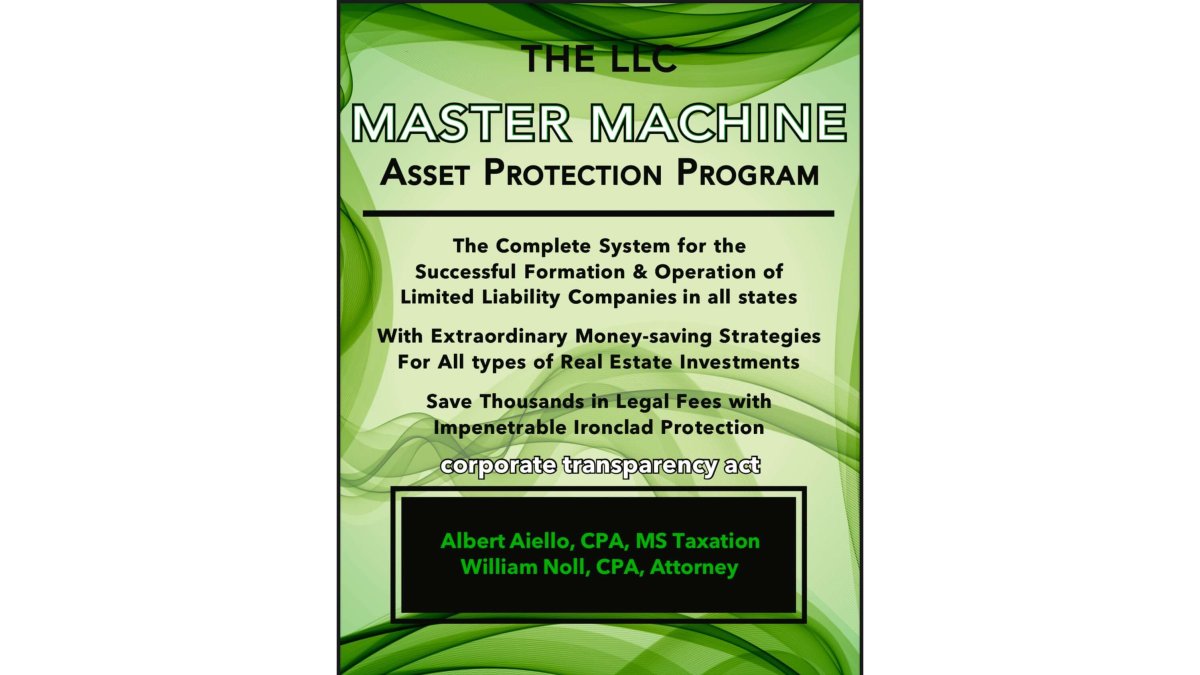
The LLC Master Machine Asset Protection →
-
Review the operating agreement and update the member schedule, capital accounts, and succession language
-
Update beneficiary and transfer-on-death designations as estate plans change
-
Re-evaluate whether the holding/operating structure still matches the portfolio
-
The state of formation governs the internal affairs of the LLC, the operating agreement, member rights, and charging order protection.
-
Each state where the LLC does business governs registration, annual reports, franchise taxes, and the registered agent requirement. Operating without a foreign registration in a state where you hold property can bar the LLC from using that state's courts to enforce its own contracts.
-
The owner's home state governs personal income tax on distributions and, in some states, imposes its own franchise or privilege tax on the out-of-state entity.
-
A registered agent is required in every state of registration, and the agent's address, not the owner's, is the address of record.
IRS Publication 3402 on LLC taxation covers the federal tax treatment that underlies any state-level structuring decision.
Frequently Asked Questions
Should I create an LLC to protect my assets?
An LLC creates a separate legal entity that can shield personal assets from business liabilities. For real estate investors, this means a lawsuit against one property typically cannot reach your personal home or other investments. However, protection depends on proper formation and ongoing maintenance. An LLC with incomplete documents or commingled funds offers little protection. The LLC Master Machine Asset Protection Program includes a 240+ provision operating agreement designed to establish strong liability shields for real estate operations.
What is the role of an operating agreement in asset protection?
An operating agreement is the foundational document that establishes your LLC's structure, management, and member rights. For asset protection, it must include provisions that limit member liability, define management authority, and establish procedures for maintaining the corporate veil. Generic agreements often lack these protections. A comprehensive operating agreement with 240+ legal provisions addresses tax elections, entity formalities, and compliance requirements that courts examine when determining whether to uphold your liability shield.
What are common LLC mistakes to avoid?
The most damaging mistakes include commingling personal and business funds, failing to maintain separate bank accounts, skipping annual filings, and using generic operating agreements that lack protective provisions. Other errors include inadequate capitalization, not documenting member decisions, and treating the LLC as an extension of personal affairs. Each mistake gives creditors grounds to pierce the corporate veil. Following a post-formation maintenance checklist and using comprehensive formation documents significantly reduces these risks.
Which is better for asset protection, an LLC or a trust?
LLCs and trusts serve different purposes and often work together. An LLC provides liability protection for business operations and real estate holdings, separating business assets from personal assets. A trust can provide privacy, estate planning benefits, and additional asset protection through structure. Many investors use both: an LLC to hold properties and a trust to hold LLC membership interests. The Shield Protector System explains how trust-based planning integrates with LLC structures for comprehensive wealth protection.
How does a holding company structure enhance asset protection?
A holding company structure separates ownership from operations. The holding company owns the LLCs that hold individual properties or run businesses. If a lawsuit targets one operating entity, the holding company's other assets remain protected. This structure also simplifies management across multiple properties and can provide tax advantages. The LLC Master Machine & Equity Stripping Excel Bundle explains how to implement holding company structures alongside equity stripping strategies for layered protection.