

Table of Contents
- Why Tax Planning Matters for Rental Property Investors
- Rental Property Tax Deductions List: What You Can Write Off
- Short-Term Rental Tax Strategy and Active Income Classification
- Tax Benefits of LLC for Rental Property Ownership
- Depreciation, Cost Segregation, and 1031 Exchanges
- Passive Activity Loss Rules and Real Estate Professional Status
- Year-End Tax Planning and Recordkeeping for Audit Protection
- Conclusion
Last Updated: August 28, 2026
Why Tax Planning Matters for Rental Property Investors
Tax planning isn't a luxury for real estate investors, it's the difference between keeping your profits and handing them over unnecessarily. Many property owners discover too late that they've paid thousands in taxes they could have legally avoided through proper structuring and strategic planning.

At Information Services Unlimited, we've worked with rental property investors who realized their tax burden could have been cut dramatically with the right approach. The problem is that most investors treat taxes as an afterthought, filing their returns based on whatever their accountant calculates rather than building a tax strategy from the ground up.
Here's what makes this critical: rental property income is taxed differently than W-2 employment income, and the rules around deductions, depreciation, and passive activity losses are complex enough that small mistakes can cost you thousands annually. The good news is that legitimate tax strategies for small rental portfolios exist, and they're accessible to investors at any scale.
Rental Property Tax Deductions List: What You Can Write Off
The foundation of any solid tax strategy for small rental portfolios starts with understanding what you can actually deduct. Many landlords leave money on the table simply because they don't know what qualifies as a deductible expense.

Operating expenses are your primary deduction category. These include mortgage interest (though not principal), property taxes, insurance, utilities you pay on behalf of tenants, repairs and maintenance, property management fees, and advertising for tenants. The IRS distinguishes between repairs (which are fully deductible) and capital improvements (which must be depreciated over time), so understanding this distinction matters.
Travel expenses related to managing your properties qualify as deductions. If you drive to inspect a property, meet with contractors, or handle tenant issues, those miles count. Keep detailed records, the IRS scrutinizes travel deductions closely. Similarly, home office expenses apply if you have a dedicated space for managing your rental business, though the calculation can be either simplified or itemized depending on your situation.
Professional fees are deductible too. This includes accounting fees, legal consultations, and tax preparation costs specifically related to your rental properties. If you work with a CPA or attorney on LLC formation and management, like the strategies Information Services Unlimited provides, these professional services reduce your taxable income.
Depreciation is separate from standard deductions and deserves its own attention. You can depreciate the building itself (not the land) over 27.5 years for residential properties (irs.gov). This is a significant deduction that reduces your taxable income even though it's a non-cash expense. The building's cost basis determines how much you depreciate annually.
Short-Term Rental Tax Strategy and Active Income Classification
Short-term rentals (typically properties rented for fewer than 30 days) face different tax treatment than long-term rentals, and this distinction dramatically affects your tax liability.
Short-term rental income is classified as active income, meaning you can offset it with losses from other business activities. This is fundamentally different from long-term rental income, which is typically classified as passive activity. The active versus passive distinction determines whether you can use losses to reduce your W-2 income from employment or other sources.
If your short-term rental qualifies as an active business (which requires material participation, generally 100+ hours annually or being the primary decision-maker), you can deduct losses against your ordinary income. For many small investors, this creates significant tax advantages. A property that generates a loss in its first year due to depreciation and expenses can shelter thousands of dollars of your employment income from taxation.
The catch is documentation. The IRS closely examines short-term rental businesses to ensure they're legitimate operations, not hobby activities. You need detailed records showing your active involvement: time logs, maintenance records, guest communications, and evidence of marketing efforts. Without this documentation, the IRS may reclassify your business as a hobby, disallowing losses entirely.
State regulations also matter. Some states tax short-term rentals differently than long-term rentals, and some municipalities require licensing or impose occupancy limits. Before structuring your short-term rental tax strategy, verify your local requirements. This is where working with professionals familiar with real estate tax strategies for small rental portfolios becomes valuable, they understand both federal rules and your state's specific requirements.

Tax Benefits of LLC for Rental Property Ownership
Forming an LLC for your rental properties provides both asset protection and tax advantages, making it a foundational decision in structuring a small rental portfolio.
The tax benefits of LLC for rental property ownership start with flexibility. An LLC can be taxed as a sole proprietorship, partnership, or S-corporation depending on your elections. This flexibility allows you to choose the most advantageous structure for your specific situation. For many small investors, an LLC taxed as an S-corporation can reduce self-employment taxes significantly.
Here's how it works: as a sole proprietor, you pay self-employment tax (approximately 15.3%) on all net rental income. An S-corporation election allows you to pay yourself a reasonable W-2 salary and take the remainder as distributions, which aren't subject to self-employment tax (irs.gov). For a property generating $50,000 in net income, this election could save you $2,000-3,000 annually.
Beyond tax treatment, an LLC provides liability protection. If a tenant is injured on your property and sues, the judgment generally cannot reach your personal assets if they're held outside the LLC. This separation of personal and business assets is crucial for investors managing multiple properties.
Multi-member LLCs (partnerships) face additional complexity. Each partner's share of income and losses flows through to their personal tax return, but the allocation doesn't have to be equal to ownership percentages if there's a partnership agreement supporting it. This flexibility allows partners to allocate losses strategically, for example, to the partner with higher W-2 income who benefits most from loss deductions.
The tax benefits of LLC for rental property ownership also include the ability to make strategic elections around passive activity classification. By structuring your LLC as a real estate professional entity (if you qualify), you can treat rental losses as active losses, allowing them to offset your W-2 income without the $25,000 annual limitation.
Depreciation, Cost Segregation, and 1031 Exchanges
These three strategies form the advanced tier of tax planning for rental property investors, each offering distinct advantages for reducing tax liability.

Depreciation is the most straightforward. Residential rental property depreciates over 27.5 years; commercial property over 39 years. You calculate the depreciable basis by taking your purchase price minus the land value (land doesn't depreciate). This annual deduction reduces your taxable income without any cash leaving your account. Over time, this non-cash deduction can create years where you show a loss on paper despite positive cash flow.
Cost segregation studies accelerate depreciation by breaking down building components into shorter depreciation schedules. A roof, HVAC system, or flooring might depreciate over 5-15 years rather than 27.5 years. A cost segregation study involves a professional engineer analyzing your property and identifying components that qualify for accelerated depreciation. The upfront cost of the study (typically $2,000-5,000) is recouped through years of additional tax deductions.
A 1031 exchange allows you to defer capital gains taxes indefinitely by selling one property and purchasing another of equal or greater value within specific timeframes (45 days to identify, 180 days to close). This strategy is powerful for investors looking to upgrade properties or consolidate holdings without triggering capital gains taxation. The deferred tax amount can then be reinvested in your new property, compounding your growth.
The interaction between these three strategies matters. If you use cost segregation to accelerate depreciation, you'll owe depreciation recapture tax (25%) when you sell. A 1031 exchange defers this recapture tax along with capital gains, preserving more capital for reinvestment.
Passive Activity Loss Rules and Real Estate Professional Status
Understanding passive activity loss limitations is essential because they determine how much of your rental losses you can actually use to reduce your overall tax liability.
Passive activity losses are limited to $25,000 annually if your modified adjusted gross income (MAGI) is below $100,000 (irs.gov). The limit phases out by 50 cents for every dollar of MAGI above $100,000, disappearing entirely at $150,000 MAGI. Excess losses carry forward indefinitely, usable only against passive income in future years or when you sell the property.
This limitation is why real estate professional status matters so much. If you qualify as a real estate professional, your rental losses are classified as active losses, not passive losses. Active losses can offset your W-2 income without limitation. The IRS defines a real estate professional as someone who:
- Spent more than half their working hours in real property business activities
- Spent at least 750 hours annually in real property business activities
For investors working full-time in other careers, qualifying is difficult. But for those who manage their properties actively, keep detailed time records, and work with professionals experienced in real estate tax strategies for small rental portfolios, qualification is achievable.
The documentation requirement is strict. The IRS wants contemporaneous records, time logs, calendars, or other evidence created at the time of the activity, not reconstructed later. Many investors fail to qualify not because they don't meet the hours requirement, but because they can't prove it.
Year-End Tax Planning and Recordkeeping for Audit Protection
The final months of the year are when tax strategy becomes actionable. Year-end planning allows you to make decisions that directly reduce your tax liability before the year closes.
Timing discretionary expenses strategically can shift income between tax years. If you're planning a major repair or replacement, completing it before year-end allows you to deduct it in the current year rather than deferring to next year. Similarly, prepaying property taxes or insurance in December of a profitable year reduces that year's taxable income.
Equipment purchases deserve special attention. The Section 179 deduction allows you to immediately deduct the full cost of certain property and equipment (up to annual limits) rather than depreciating it. A new HVAC system, appliances, or flooring installed before year-end qualifies. This creates a large deduction in the year of purchase.
Bonus depreciation is another year-end strategy. Qualified property placed in service before December 31 can be fully depreciated in that year. Combined with cost segregation studies, this can create substantial deductions in high-income years.
Recordkeeping is where many investors stumble. The IRS allows deductions for expenses you can document. Without records, you lose the deduction entirely. Maintain receipts, invoices, and bank statements for all rental-related expenses. Digital organization systems make this manageable, photograph receipts, use accounting software, and back everything up.
Depreciation schedules require particular attention. The IRS Form 4562 (Depreciation and Amortization) requires detailed records of every depreciable asset, its cost, the date placed in service, and the depreciation method. Errors here trigger audits. Using professional tax preparation specifically designed for rental properties, like the strategies outlined in Information Services Unlimited's resources, ensures accuracy.
Documentation also protects you in an audit. The IRS doesn't just disallow expenses; they impose penalties for inadequate substantiation. Contemporaneous written evidence (created at the time of the transaction, not later) is your defense. Maintain a property management file for each rental: lease agreements, tenant communications, maintenance records, contractor invoices, and photographs of conditions before and after repairs.
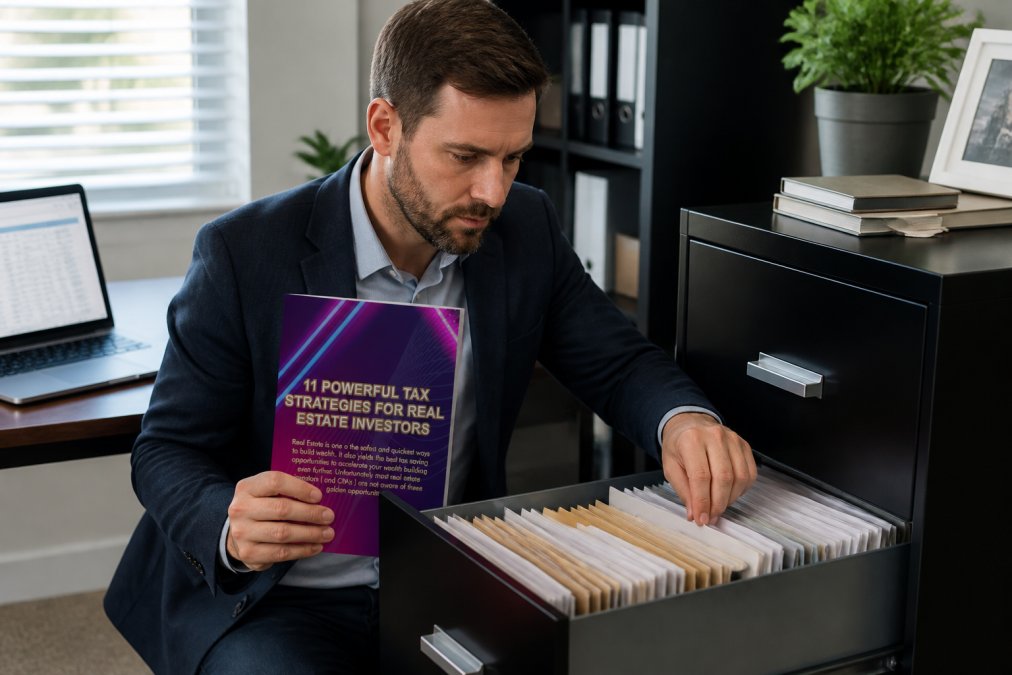
Structuring tax strategies for small rental portfolios requires understanding both the rules and how they interact. From deductions and depreciation to passive activity classification and year-end planning, each decision compounds over time. The resources available through Information Services Unlimited, including guides like the 11 Powerful Tax Strategies For Real Estate Investors and the 37 Brilliant Tax Reduction Tips for Real Estate Investors, provide the frameworks and checklists needed to implement these strategies correctly. Start with proper documentation and entity structure, then layer in advanced strategies like cost segregation and real estate professional status as your portfolio grows. The goal isn't to avoid taxes illegally; it's to understand the tax code well enough to minimize what you owe while building wealth through real estate.
Frequently Asked Questions
What is the difference between active and passive income for rental properties?
Active rental income comes from properties where you materially participate (typically short-term rentals or properties you actively manage). Passive income comes from long-term rentals where you're not actively involved. The distinction matters because passive losses face limitations under IRS rules, you generally can't offset W-2 wages with passive losses unless you qualify as a real estate professional. Understanding this classification helps you structure tax strategies for small rental portfolios correctly.
What rental property tax deductions list should I track for my portfolio?
Key deductions include mortgage interest, property taxes, insurance, repairs, maintenance, utilities, advertising for tenants, property management fees, depreciation, travel to properties, home office expenses (if applicable), and professional services like accounting and legal fees. The IRS distinguishes between repairs (fully deductible) and capital improvements (depreciated over time). Keep detailed records of all expenses, this documentation is critical if audited. For a comprehensive rental property tax deductions list tailored to your specific situation, review the '37 Brilliant Tax Reduction Tips for Real Estate Investors' resource.
How does short-term rental tax strategy differ from long-term rental treatment?
Short-term rentals (under 30 days) are often classified as active business income, allowing you to deduct losses against other income and potentially claim the home office deduction. Long-term rentals generate passive income, which limits loss deductions unless you qualify as a real estate professional. Your short-term rental tax strategy should account for self-employment taxes, which don't apply to passive rental income. Consult the 'Year-End Tax Planning Strategies for Real Estate Investors' guide for timing strategies specific to your rental type.
What are the tax benefits of LLC for rental property ownership?
An LLC provides liability protection, separating personal assets from rental property debt and lawsuits. Tax-wise, a single-member LLC is treated as a sole proprietorship by default (you still report on Schedule E), but a multi-member LLC taxed as a partnership allows income splitting and can reduce self-employment taxes. An LLC also enables tax-deferred exchanges (1031 exchanges) more easily and provides audit protection through clearer documentation of business operations. The tax benefits of LLC for rental property also include flexibility in cost segregation studies and depreciation strategies. Proper LLC structuring requires careful setup and maintenance, review our resources on LLC formation for real estate investors.
This article was written using GrandRanker